The making of a ‘Fake Out-of-home’ advertising video for social


As part of a larger campaign for their new, more sustainable tennis ball packaging, Dunlop called on us to create an impactful launch teaser.
We took centre stage at the ATP Tour Finals in Turin, collaborating with Italian tennis influencer @edoardosantonocito to craft a ‘FOOH’ video that would build perfect momentum for the launch.

Concepting
As the host city for the ATP Finals tournament, Turin sparked our creative direction, and the city’s iconic landmarks became the cornerstone of our FOOH video concept. We pitched several ideas: giant tennis tubes replacing Turin’s historic trams, tennis balls racing around the Fiat building’s rooftop track (inspired by The Italian Job). The winning concept featured a giant campaign poster cascading down the tower beside the PALA Alpitour – the ATP Tour Finals arena. As it unfurled, tennis balls burst from the 2D poster into the real world.


Storyboarding
Our next stage was to storyboard the video to bring the concept to life. We storyboarded two creative ways for the balls to come out of the poster. The first showed the poster filling up with tennis balls before releasing them all. The second, which became our final choice, featured a fresh tube firing out the new paper lid into the foreground, followed by four tennis balls popping out of the tube into the scene.


Pre-production
With the location locked in, we had our boots on the ground – a Dunlop team member local to Turin who surveyed the site and snapped plenty of reference photos. This would help us spot any potential filming challenges and avoid any nasty surprises (more on that a bit later).
The project’s success hinged on two key elements: meticulous planning and collaboration between the team.
The most crucial element was ensuring the Turin footage would be compatible with our CGI work. To get the timing right, we shot a test video that allowed both videographer and CGI team to check angles and timing, making adjustments where needed. Since it was being filmed remotely, a pre-production meeting bringing everyone together was essential – this let us work through any creative or technical questions, confirm timings, and the shoot date.
Production
The production phase saw a local videographer working alongside our influencer, with our team providing remote art direction for camera angles and timing. This approach allowed us to maintain creative control while working efficiently within budget constraints.

Post Production
Within a day, we had received the footage and immediately began work on post-production, adding in the CGI elements. Remember those nasty surprises I mentioned? Well, as with all the best laid plans, the footage needed a little bit of touching up to remove a few …blips: a stray security guard strolling into the shot on the best take and an unexpected construction site causing some loud background noise. Thankfully, these unwanted elements were easily removed.
Now it’s really time to get into the CGI…
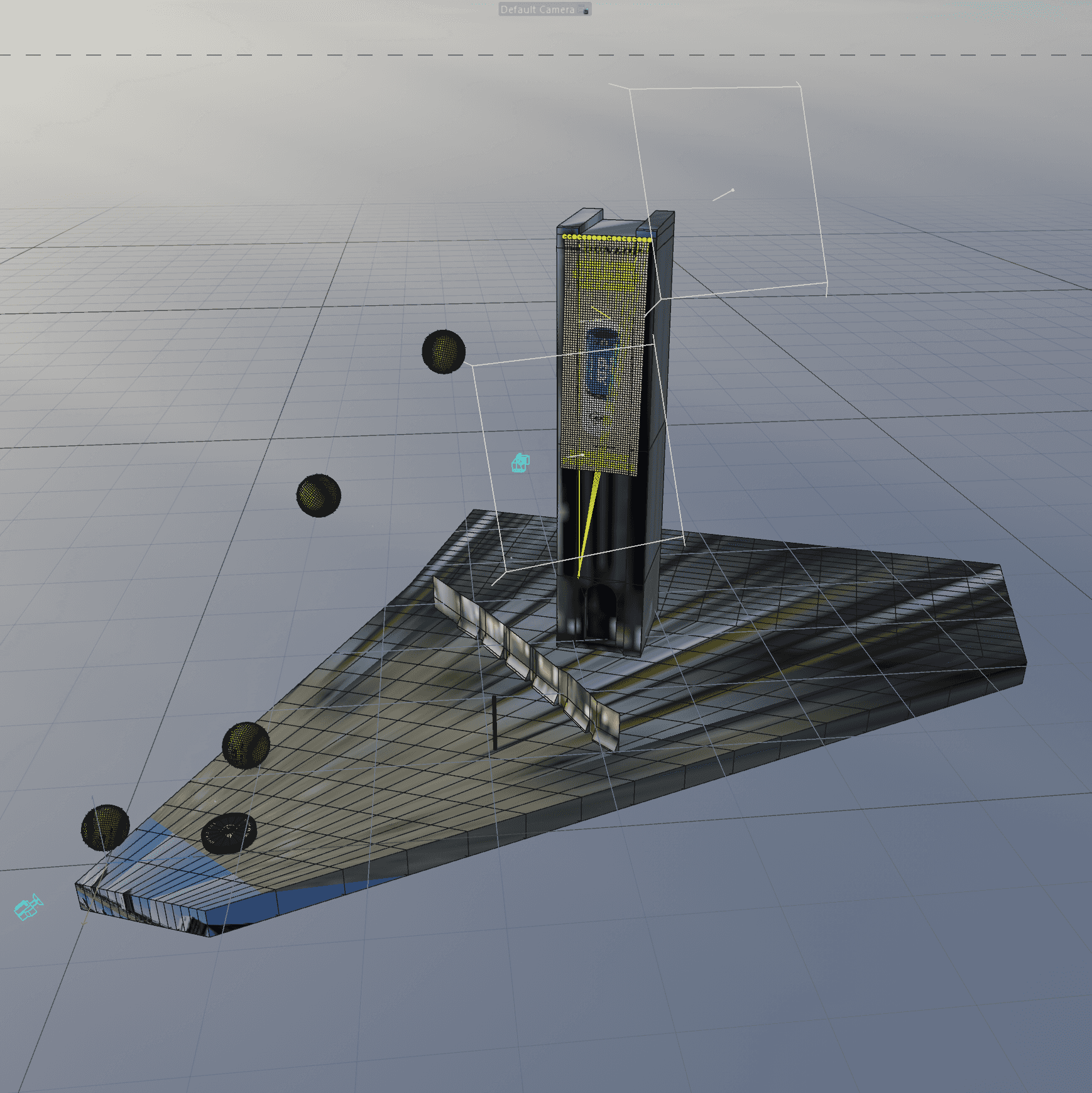
Our first challenge was nailing the 3D camera move. Since we only had rotation to work with (no side-to-side movement), we got clever with our 3D solve. Using a camera calibrator, we analysed all the obvious straight lines in our shot – the tower’s edges, those converging parking lines on the ground – and calculated their vanishing points. This let us precisely recreate our camera’s position in 3D space, essentially reverse-engineering reality into our digital world.


The 3D scene is locked down to the original footage. Using the footage, projected from the view of the camera, to rebuild objects in the scene in 3D. This allows for shadows to be cast realistically, and for objects to interact correctly when running the physics simulation later on.
Once the scene was ready, we added the animated elements: the unfurling of the poster, the tilting tennis ball tube, the flying lid and bouncing tennis balls.
We positioned the tube inside the building and crafted a precise physics simulation for the lid launch. Nailing the perfect pop took some fine-tuning – balancing speed, direction, and spin until the lid landed exactly where we wanted it, sliding smoothly into frame.
We rendered everything in passes and brought it together in After Effects, adding subtle camera movements to amp up the impact of each ball hitting the ground. With the client’s seal of approval on the animation, we layered in the sound effects over the top – the finishing touch that brought our ‘FOOH’ moment to life.
The future of outdoor advertising
This project really showcases what FOOH advertising can do – it packs the punch of traditional outdoor advertising while offering digital flexibility at a fraction of the cost. Brands can now tell location-specific stories that resonate globally, without the logistical headaches and expense of physical installations.
And in a world pushing for more sustainability, why create more waste when a digital approach can deliver just as much impact?
The success of this project shows audiences are hungry for this blend of digital creativity and physical spaces: already, our activation video has garnered 1.3M views (and counting!) and 47.1K likes on Edoardo Santonocito’s Instagram channel.
FOOH opens up a whole new playground where digital creativity meets real-world spaces. And we’re just getting started.
Talk to us about bringing your campaign to life